
Restaurant Seating Guide: Booth, Chair, or Bar Stool?
Restaurant seating breaks into four main formats: booth, dining chair, bar stool, and banquette, each chosen for service model, table turnover rate, and ergonomic fit for the length of the meal.
Seating choice shapes dwell time, table density, and brand atmosphere. Here is a practical breakdown of when to specify booths, dining chairs, or bar stools, and how to mix them effectively across zones.
Quick answer: Each seating type serves a different dining concept. Booths maximize comfort and privacy for casual and family dining. Dining chairs offer the most flexibility for repositioning and event use. Bar stools define the counter and high-top zone. Most successful restaurant layouts use all three in distinct areas. Seating is also just one line in a wider furniture package — our hospitality FF&E procurement guide covers how the full scope comes together.
When Should a Restaurant Choose Booth Seating?
Booths are a defining element of casual dining, family restaurants, and diner-style concepts. Their enclosed form creates a sense of privacy that encourages guests to linger, which supports higher check averages per cover. A well-configured booth row can also achieve better seat density than equivalent four-top tables with chairs, because the back-to-back arrangement eliminates the aisle space that freestanding chairs require behind each seat.
Commercially, booths are typically built with a solid wood or plywood frame, upholstered seat and back panels, and a laminate or HPL-faced side and top cap. The upholstery grade matters significantly for durability: contract-grade vinyl or commercial fabric rated for 100,000+ double rubs (Wyzenbeek abrasion test, per the Association for Contract Textiles heavy-duty guideline) will outlast consumer-grade materials in a high-turn environment. Vinyl is the easier maintenance choice for food-service settings where spills are frequent.
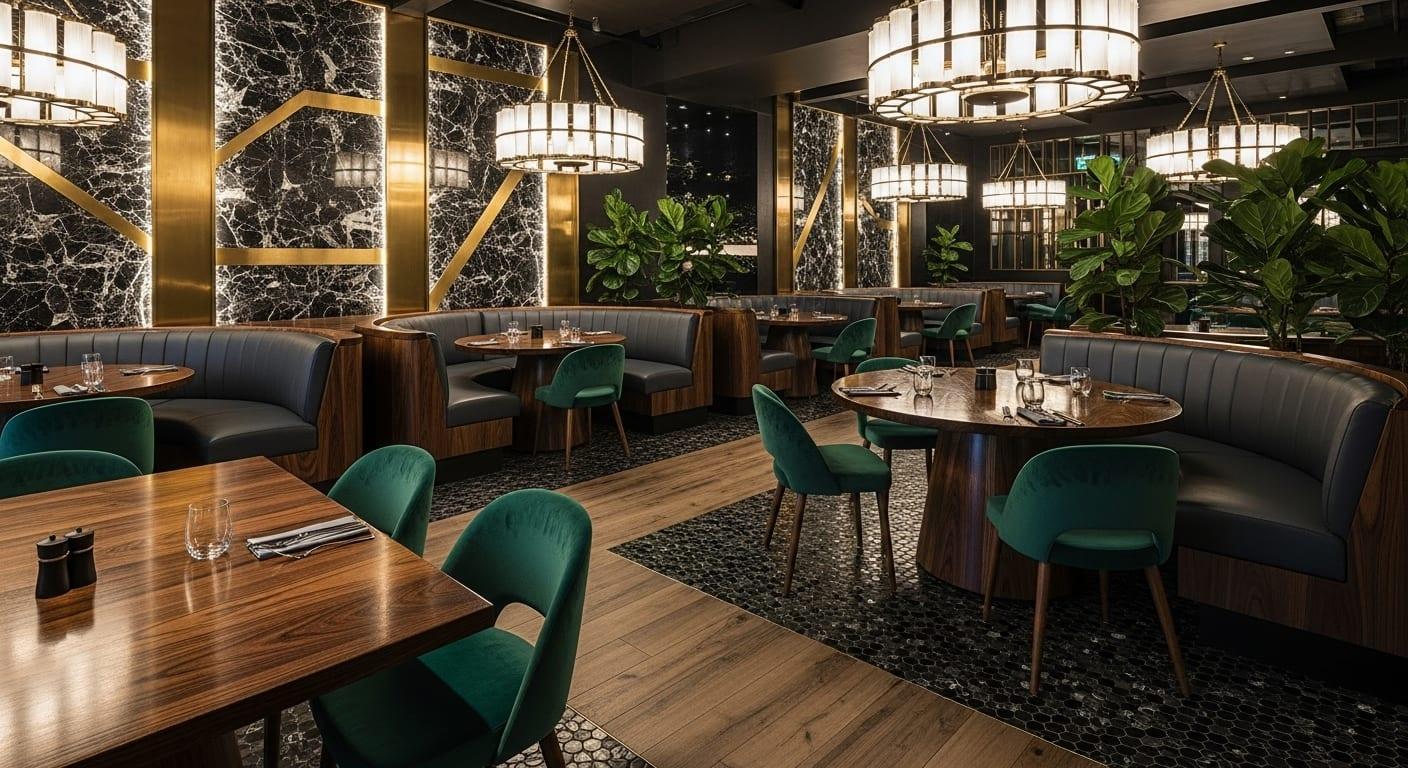
Booths work best along perimeter walls and in sectioned dining rooms where the layout does not need to flex. They are less suitable for event-capable spaces that need to be reconfigured, because booths are fixed to the floor or wall and cannot be moved.
When Are Dining Chairs the Right Choice?
Dining chairs are the most versatile restaurant seating option. They can be rearranged to accommodate parties of different sizes, pushed against walls to open floor space for events, and stacked for storage if the venue doubles as a function space. Their wide range of available styles, from cross-back wood chairs to upholstered side chairs with metal frames, makes them suitable for fine dining, bistros, cafes, and casual concepts alike.
For commercial use, the key specification considerations are frame material, stack ability, and weight. Powder-coated steel frames are extremely durable and lightweight. Solid wood frames carry a warmer aesthetic but require more maintenance over time. Stackable chairs reduce storage footprint significantly, which matters for venues that host private events or need to clear the floor quickly.
Seat height for standard dining chairs is typically 17 to 19 inches, pairing with 28 to 30-inch dining tables. Confirm the chair and table heights are coordinated before finalizing specifications. A mismatch of even two inches creates a poor guest experience at scale.
Browse DMD's restaurant dining chairs, booths, and outdoor seating options in the product catalog.
View Restaurant ProductsWhen Should You Specify Bar Stools?
Bar stools define the energy of a counter or high-top zone. They draw guests closer to the action, whether that is an open kitchen, a full bar, or a window counter with street views, and support a faster, more casual dining tempo that tends to increase table turns.
Bar stools are available in fixed-height and adjustable-height configurations. Counter height stools (seat height 24 to 26 inches) pair with 34 to 36-inch counter surfaces. Bar-height stools (seat height 28 to 30 inches) pair with 40 to 42-inch bar tops. Confirming the stool-to-surface pairing before ordering is essential, as mixing heights creates ergonomic problems for guests.
Foot rails matter for guest comfort at bar seating. A fixed foot rail at the base of the bar or counter, or a built-in rung on the stool frame itself, reduces fatigue on extended seatings. For stools with backs, the back height should not interfere with the underside of the bar overhang. For backless stools, consider whether the concept calls for guests to face the counter only or also turn to face the room.
Booth vs. Chair vs. Bar Stool: How Do the Three Compare?
The table below summarizes how the three core seating types trade off against each other across the factors that matter most to operators: floor density, cost, durability, and table-turnover speed.
| Seating type | Capacity per sq ft | Relative cost per seat | Durability | Table-turnover speed | Best for |
|---|---|---|---|---|---|
| Booth | Highest — back-to-back rows eliminate aisle space behind seats | Highest — custom frames, upholstery, and fixed installation | Excellent with contract-grade vinyl and HPL caps | Slowest — privacy encourages guests to linger | Casual and family dining along perimeter walls |
| Dining chair | Moderate — each seat needs pull-out clearance and aisle space | Moderate — but higher replacement and maintenance over time | Good to excellent, depending on frame material | Moderate — standard full-service pacing | Flexible main dining floors and event-capable spaces |
| Bar stool | High — dense spacing at counters and high-tops | Lowest — simpler frames, minimal upholstery | Good — check footrail and swivel wear points | Fastest — casual tempo drives quicker covers | Bar counters, open kitchens, and window rails |
How Should You Specify Outdoor Restaurant Seating?
Patio and terrace dining introduces material requirements that differ significantly from interior seating. Every component (frame, seat surface, hardware) must withstand UV exposure, humidity, rain, and temperature cycling without degrading quickly.
Powder-coated aluminum is the most common frame material for outdoor commercial seating because it resists corrosion, is lightweight, and holds color well under UV. Galvanized or stainless steel is more durable but heavier. Teak and other dense hardwoods are popular for premium outdoor aesthetics but require periodic oiling to maintain appearance.
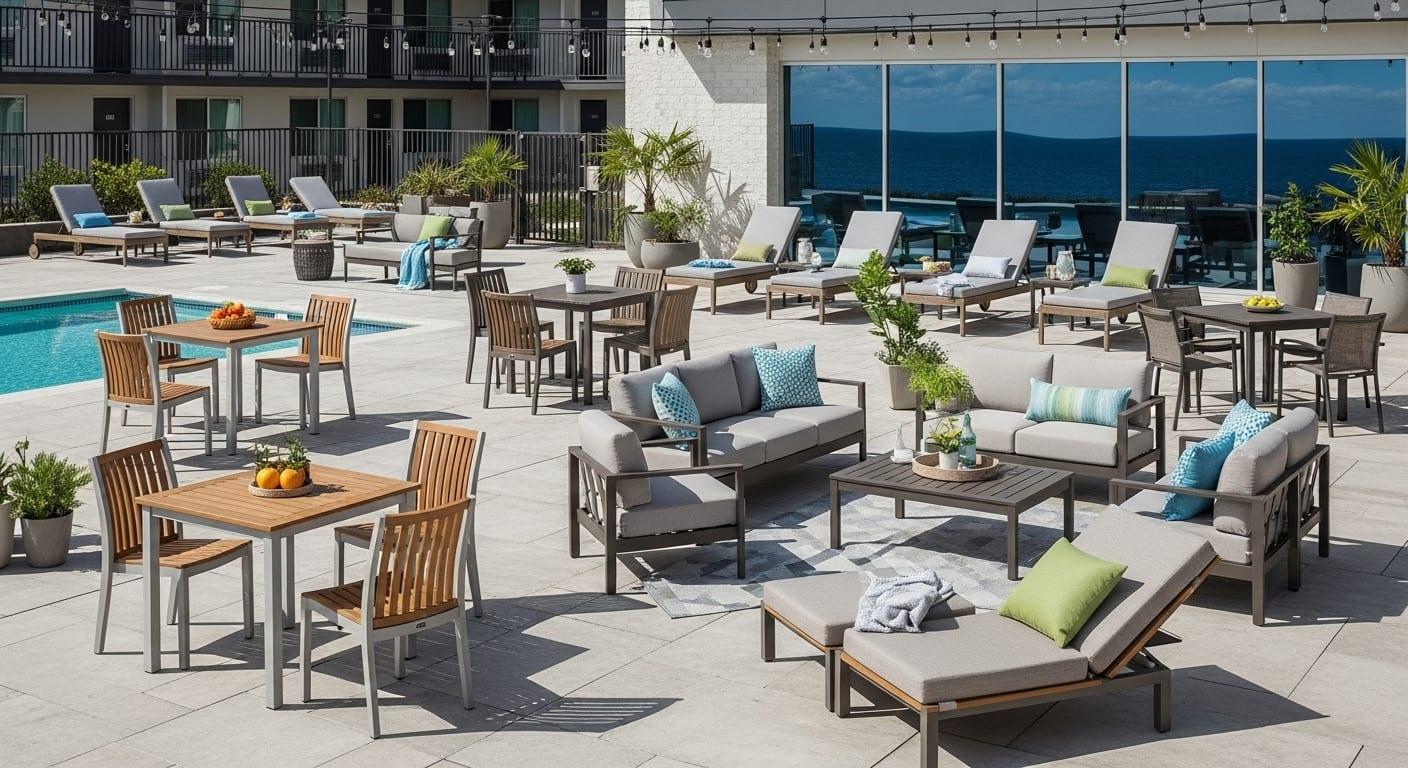
Seat surfaces for outdoor dining chairs and bar stools should be either all-weather woven (synthetic resin wicker), slatted wood, perforated metal, or solution-dyed acrylic fabric: materials that drain water, dry quickly, and resist fading. Standard interior upholstery fabrics are not suitable for outdoor use and will degrade within one season.
Patio tables paired with outdoor chairs should also be specified with weather-resistant bases (powder-coated steel or cast iron) and tops in HPL, porcelain, or powder-coated aluminum. Glass tops are generally avoided in outdoor settings due to wind and breakage risk.
How Do You Plan Aisle Width, Table Spacing, and ADA Compliance?
Restaurant layout directly affects revenue per square foot, guest comfort, and code compliance. The National Restaurant Association publishes operational guidance on space planning and seating efficiency that operators and designers regularly reference. General industry practice calls for a minimum 18 inches of seat clearance between the back of one chair and the adjacent table edge. Primary circulation aisles should be at least 36 inches wide; secondary aisles between tables can be narrower but should not fall below 24 inches in occupied areas.
ADA guidelines require at least 5 percent of tables to be accessible, with a minimum of one accessible table per seating area. An accessible table requires knee clearance of at least 27 inches high, 30 inches wide, and 19 inches deep, and a clear floor space of 30 by 48 inches adjacent. Fixed booth seating along a wall does not satisfy ADA requirements on its own. At least some accessible seating must be provided at movable tables.
For bar and counter areas, ADA requires a portion of the counter or bar to be no higher than 34 inches above the finished floor for wheelchair access, unless the operator can demonstrate that lowering the counter would fundamentally alter the nature of the business.
Which Materials Hold Up in High-Traffic Environments?
Commercial restaurant seating takes significantly more abuse than residential furniture. A busy restaurant may turn a seat 300 to 400 times per week. Specifying contract-grade materials from the outset avoids early failures and costly mid-life replacements. If budget pressure forces trade-offs, our guide to value engineering commercial furniture shows where to save without sacrificing durability.
- Upholstery: Specify commercial-grade abrasion-rated seating fabric. For high-spill areas, commercial vinyl or treated performance fabric with a moisture barrier is preferred.
- Frames: Powder-coated steel or solid hardwood frames with glued and blocked corner construction outlast welded wire or stapled joints under repeated use.
- Seating foam: High-density foam (1.8 lb density minimum) resists permanent compression better than standard residential foam over time.
- Surface laminates: High-pressure laminate (HPL) booth caps and table surfaces resist scratching and moisture far better than low-pressure or thermofoil finishes.
How Do You Mix Seating Types Across Dining Zones?
Most successful full-service restaurants use multiple seating types organized into distinct zones rather than a single seating type throughout. A common configuration for a mid-size casual dining restaurant might look like this:
- Bar zone: Bar stools at the counter or high-top tables near the entrance or bar service area, supporting quick turns and a social atmosphere.
- Main dining floor: Dining chairs at four-top and two-top tables, providing flexibility for party-size variations and event reconfiguration.
- Perimeter booths: Fixed booths along walls for parties of two to four who prefer privacy, with upholstered backs and vinyl seats for durability.
- Patio or terrace: Weather-resistant outdoor chairs and patio tables, maintaining visual consistency with the interior palette through coordinated powder-coat colors and material tones.
Zone separation can be reinforced through flooring material transitions, ceiling height changes, partial walls or banquettes, and lighting level differences, all of which complement the seating choice to create distinct atmospheres within one space. Fixed booths and custom banquettes carry the longest lead times of any seating format, so place them early in the FF&E procurement timeline to protect the opening date.
Explore the full dining area product range including chairs, booths, and bar stools for commercial restaurant projects.
View Dining Area ProductsFrequently Asked Questions
How do I decide between booths and dining chairs for a new restaurant?
Start with your concept and layout flexibility needs. If your floor plan is fixed and the concept is casual or family dining, booths along perimeter walls maximize comfort and density. If you need to reconfigure for events or private dining, dining chairs give you the flexibility booths cannot provide. Many operators use both.
What seat height should I specify for bar stools?
Match the stool height to the counter or bar surface: counter-height stools with 24 to 26-inch seat heights pair with 34 to 36-inch counters, while bar-height stools with 28 to 30-inch seat heights pair with 40 to 42-inch bar tops. Always confirm surface height before ordering stools to avoid ergonomic mismatches.
What materials hold up best for outdoor restaurant seating?
Powder-coated aluminum frames with all-weather woven seats or perforated metal surfaces are the most durable and lowest-maintenance option for outdoor commercial seating. Avoid standard interior upholstery outdoors; it degrades quickly under UV exposure and moisture. Solution-dyed acrylic fabric is acceptable if covered patios limit direct rain exposure.
How many seats can I fit per square foot in a restaurant?
A common benchmark for casual dining is 15 to 18 square feet of total dining room area per seat, which accounts for table space, chair clearance, and circulation aisles. Fine dining concepts typically allocate more space per seat. High-top bar seating is denser. Confirm local fire and occupancy codes, as they set the binding limits for your specific space.