Published · Updated · By DMD Furnishing Editorial Team
Hotel Guestroom Furniture Checklist: What Every Room Needs
A hotel guestroom furniture checklist is the complete roster of casegoods, seating, soft goods, lighting, and fixtures required to outfit one room at the brand standard, from the bed and headboard to the luggage bench and in room seating.
Every hotel guestroom requires a defined set of furniture pieces to meet brand standards, pass franchisor inspection, and deliver the guest experience the property promises. This checklist covers every major casegood, seating, and specialty piece, along with key commercial specification considerations for each.
Why Does a Hotel Furniture Checklist Matter?
A complete hotel guestroom furniture checklist matters because a single missing piece can fail a brand QA audit, delay the certificate of occupancy, and force last-minute substitutions that break the design intent. Using a structured checklist during design development ensures every line item has a confirmed quantity, spec sheet, and lead time before procurement opens.
Hotel guestroom FF&E is specified room by room, and even a single missing or undersized piece can trigger a punch list item that delays the certificate of occupancy or fails a brand quality assurance audit. Industry coverage from Hotel Business frequently highlights how QA audit failures trace back to incomplete FF&E procurement rather than design deficiencies. Having a complete checklist during the design development phase ensures nothing is budgeted for, specified, and then forgotten before delivery.
The checklist also serves as a procurement tool. Each line item requires a quantity count, a specification sheet, and a lead time estimate. Starting the furniture procurement process with an incomplete checklist is one of the most common causes of rushed orders and substitutions that compromise the design intent. For how the checklist feeds into budgeting, vendor selection, and installation, see our hospitality FF&E procurement guide.
What Bed Components Belong in a Hotel Guestroom?
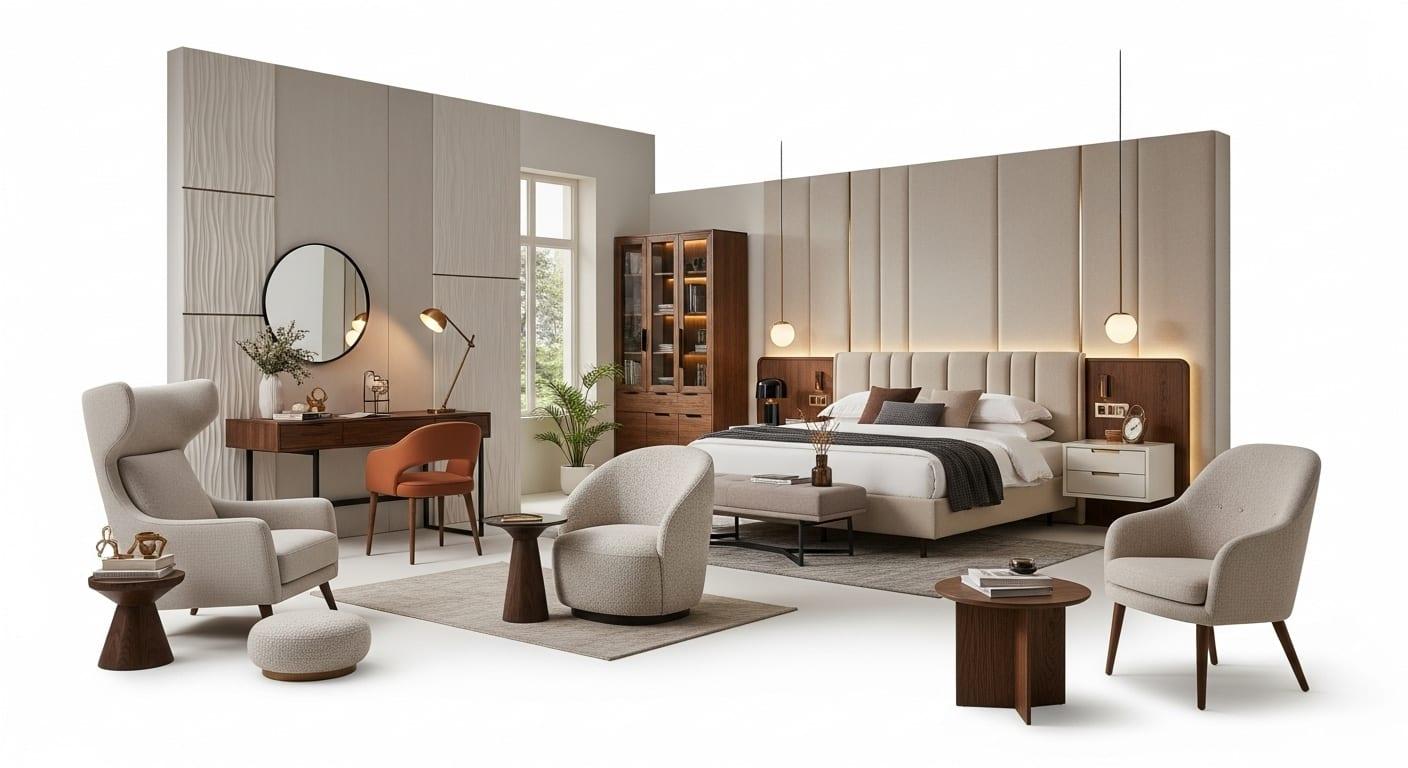
Every hotel bed breaks down into three separately specified FF&E line items: the headboard, the bed frame, and the mattress foundation. Each carries its own manufacturer, lead time, and quality spec, and the headboard in particular is often the signature design element of the entire room. Order it early.
The bed is the physical and visual centerpiece of the guestroom. It comprises multiple separate FF&E line items, each specified and often ordered independently.
Headboard
The headboard is the most visible design element in the guestroom. It is typically upholstered in a commercial-grade fabric or faux leather with a high rub-count rating appropriate for hospitality use. Headboards may be wall-mounted, attached to the bed frame, or freestanding. Size and configuration vary based on the bed type (king, queen, two doubles) and the ceiling height of the room. For properties with strong brand identity, the headboard silhouette is often a signature design element.
Bed Frame
Commercial hotel bed frames are engineered for repetitive loading well above residential standards. They are typically constructed from powder-coated steel or solid wood and designed to accommodate commercial innerspring or hybrid mattress foundations. Bed frames in hospitality environments must resist racking, maintain alignment over thousands of use cycles, and allow housekeeping staff to change linens efficiently. Platform designs that eliminate the box spring are increasingly common.
What Casegoods Are Required in a Hotel Room?
Standard guestroom casegoods include nightstands, a dresser or wardrobe, a desk, and a luggage bench. They are typically built on an MDF or plywood substrate with HPL or wood veneer faces and commercial-grade hardware. Our guide to HPL vs veneer vs solid wood for hotel casegoods walks through the trade-offs.
Casegoods are the cabinet and storage pieces in the guestroom. In commercial hotel environments they are typically constructed from engineered wood (MDF or plywood substrate) with HPL or veneer faces, and commercial-grade hardware rated for heavy-cycle use.
Night Stand
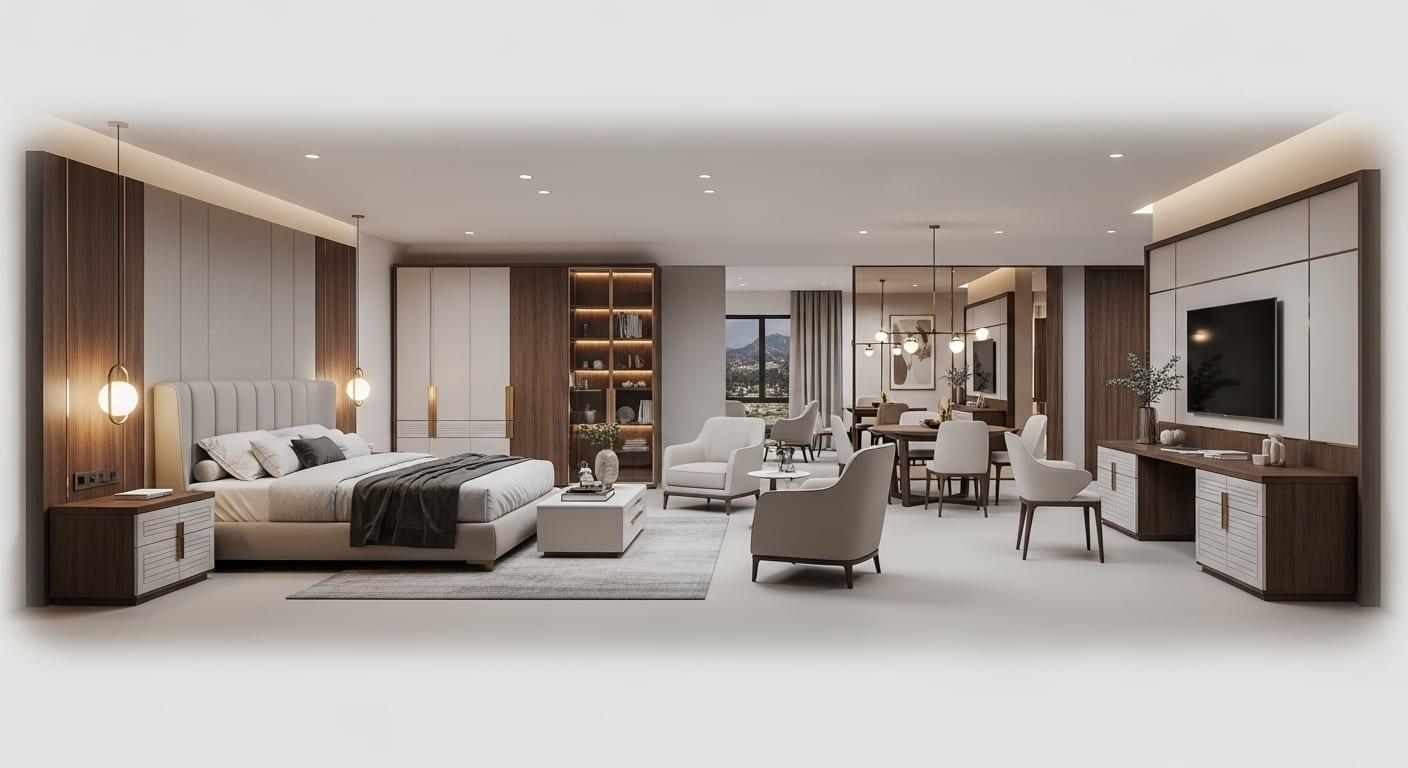
Nightstands flank the bed: one per double-bed room, two per king or queen room. Commercial nightstands typically include one or two drawers, a power outlet or integrated USB charging station on the top surface, and a shelf for phones or books. Height is coordinated with the finished mattress height, typically 26-30 inches.
Dresser / Wardrobe
Depending on room layout and property tier, guestrooms include either a freestanding dresser with multiple drawers or an open wardrobe unit with hanging space, a safe, and a shelf for the television in smaller rooms. Drawer slides must be commercial grade; soft-close undermount slides are standard for full-service properties.
Desk
The guestroom desk provides a work surface with sufficient depth for a laptop and materials. Commercial hotel desks typically include a built-in power strip or grommet with integrated outlets, and are specified with a durable HPL or veneer top surface that resists scratching and heat. A matching desk chair is specified separately.
Luggage Bench
Positioned at the foot of the bed, the luggage bench provides a firm surface for suitcases and serves as supplemental seating. Upholstered tops must use commercial vinyl or high-performance fabric rated for heavy use. Some designs incorporate a lower shelf for additional bag storage. Luggage benches are standard in all full-service and upper-midscale categories.
What Seating Is Specified for Guestrooms?
Guestroom seating almost always includes a desk chair; full-service and upscale rooms add a lounge chair with ottoman. All pieces use contract-grade upholstery with a high rub count and frames that meet commercial durability testing standards. Residential seating fails fast in hospitality use cycles.
Desk Chair
The desk chair is a commercial task or side chair that coordinates with the desk and casegood finish palette. Unlike residential task chairs, hotel desk chairs are specified for appearance rather than ergonomics, and must resist staining, be easy to clean, and withstand commercial use cycles. Weight ratings and frame material (steel, solid wood, or molded plastic) are key specification criteria.
Lounge Chair
Upscale and full-service guestrooms typically include a lounge chair and ottoman positioned near the window or in a designated sitting area. These pieces are upholstered in contract-grade fabric or leather and specified with a durable frame. They contribute significantly to the perceived luxury level of the room and are frequently featured in design renderings.
What Is a TV Media Panel?
A TV media panel is the custom millwork casegood that frames the guestroom television, houses cable and switching components, and typically integrates a dresser section or minibar. It is one of the most coordinated pieces in the room because it has to align with wall blocking, TV size, and electrical rough-in. Shop drawings usually go first.
TV Media Panel
The TV media panel is the millwork unit that houses the flat-screen television and supporting technology components (cable box, HDMI switcher, phone). In most modern hotel designs, the TV is wall-mounted directly to the panel or to a dedicated blocking structure behind it. The media panel itself provides the visual backdrop and may include open shelving, a dresser drawer section, and the minibar.
Media panels are one of the most customized pieces in the guestroom. Dimensions are coordinated precisely with the room layout, wall stud locations, and the specified television size. They are typically among the first casegood items to be drawn into shop drawings.
Amenity Storage
Amenity Tower
The amenity tower is a vertical storage unit that consolidates multiple room functions in a compact footprint. It typically houses the in-room safe, the minibar refrigerator, and additional storage, and may integrate with the TV media panel or stand independently near the room entry. Amenity towers are particularly common in urban limited-service and select-service properties where room footprints are smaller.
Bathroom Furniture
Vanity
The bathroom vanity is often specified as FF&E rather than base building, particularly in renovation projects. Commercial hotel vanities must withstand heavy moisture exposure and daily cleaning with commercial cleaning products. Substrate selection is critical: moisture-resistant MDF or plywood is essential, and surface materials must be non-porous. Vanities are typically coordinated with the bathroom tile and fixture package established by the interior designer.
DMD Furnishing manufactures the full guestroom furniture package, from headboards and bed frames to TV media panels, amenity towers, and vanities.
View hotel guestroom productsA single missing or undersized piece can trigger a punch list item that delays the certificate of occupancy or fails a brand quality assurance audit. A complete checklist is not a formality. It is the foundation of a smooth procurement process.
Media panels are among the first casegoods to enter shop drawing production. Confirm your TV size specification and wall blocking layout with the general contractor before the media panel shop drawings are issued. Dimensional mismatches discovered after production begins are costly to correct.
Complete Guestroom Furniture Checklist
Use this checklist as a starting point for your procurement schedule:
- Headboard (qty: 1 per bed)
- Bed frame (qty: 1 per bed)
- Night stand (qty: 1-2 depending on bed configuration)
- Dresser or wardrobe unit
- Desk with power integration
- Desk chair
- Luggage bench
- TV media panel
- Amenity tower (where applicable)
- Lounge chair and ottoman (full-service and upscale)
- Bathroom vanity (where specified as FF&E)
Each line item requires a confirmed specification before it can enter production. Working with a manufacturer who offers shop drawing services and mock-up room construction allows the design team to resolve coordination issues before production begins across hundreds of rooms.
Frequently Asked Questions
What furniture is standard in a hotel guestroom?
A standard hotel guestroom typically includes a bed frame, headboard, two nightstands, a dresser or wardrobe, a desk with desk chair, a luggage bench, and a TV media panel. Higher-tier properties may also include a lounge chair, ottoman, vanity, and amenity tower storage unit.
What is a hotel amenity tower?
An amenity tower is a vertical storage unit typically located in the guestroom or entry area. It houses the minibar, safe, and storage for guest belongings, often integrated with the TV media panel or positioned as a standalone casegood. It consolidates multiple room functions into a single custom millwork piece.
What materials are used for hotel guestroom casegoods?
Hotel guestroom casegoods are most commonly constructed from MDF or engineered wood substrates with either HPL (High-Pressure Laminate) or wood veneer faces. HPL offers excellent scratch resistance and consistent color at lower cost. Veneer provides a richer, more natural appearance suited to upscale properties. Solid wood is used selectively for accent pieces and structural components.
How does a luggage bench differ from a luggage rack?
A luggage bench is an upholstered, casegood-style piece that provides a firm, padded surface for suitcases and doubles as seating at the foot of the bed. It integrates with the room design and often includes built-in storage below. A luggage rack is a simple foldable frame typically stored in the closet. Luggage benches are standard in full-service and upper-midscale properties.