
Office Furniture for Commercial Projects: Procurement Guide
Commercial office procurement is a sequenced process, not a shopping trip. It starts with zone planning, moves through durability specification, and lands on a delivery schedule keyed to construction milestones, not the day someone decides they need desks.
Project managers, designers, and procurement leads who approach office furniture the way they would a retail purchase tend to hit the same problems: the chairs arrive after occupancy, the work-surface finish doesn't match the specification, or the installer shows up before the space is ready. This guide walks through the procurement process for a commercial office fit-out from standard to specification.
Quick answer: Commercial office procurement differs from retail on four dimensions: durability standards, zone planning, lead-time sequencing, and vendor coordination. Getting all four right keeps the project on schedule and the furniture performing for years. The full picture of how furniture fits into a commercial build is in our commercial furniture manufacturing guide.
How Commercial Procurement Differs from Retail
Retail office furniture is designed for individuals buying one desk or one chair. Commercial procurement covers an entire fit-out: dozens or hundreds of pieces across multiple zones, delivered and installed within a construction window, and specified to survive years of daily multi-user use. The scale difference alone changes the process, and sequencing, documentation, and accountability change with it.
In a retail transaction, the buyer picks a product, pays, and receives a box. In a commercial fit-out, the furniture specification is locked into construction drawings, finish schedules, and purchase orders that must coordinate with the general contractor's schedule. Furniture cannot be installed if the flooring is not down. It cannot move through a lobby if the elevator access window has closed. These dependencies make commercial procurement a project-management problem, not just a buying decision.
The documentation burden is also different. A commercial project requires product submittals, finish samples, lead-time confirmation, delivery scheduling, and installation supervision. Missing any step creates delays that hit the occupancy date directly. Our office furniture product line is built around this process from the first conversation.
Durability Standards: What ANSI/BIFMA X5.1 Means
ANSI/BIFMA X5.1 is the benchmark for commercial office seating in North America. It tests a chair's structural integrity, cycle count, load capacity, and stability under conditions that simulate daily commercial use. Specifying chairs that meet this standard is not a luxury on a commercial project. It is the floor.
Residential-grade chairs are tested for single-user household use. Put them in a shared office environment where multiple people use the same chair across shifts, and you will see structural failures within the first year or two. Those failures create replacement costs, warranty disputes, and in some cases, liability exposure if a chair fails under a user. Specifying to ANSI/BIFMA X5.1 at the outset is the cleaner path.
Beyond seating, work surfaces for commercial projects should be specified in materials rated for commercial use: high-pressure laminate (HPL), solid-core panels, or hard- wearing lacquer-finished wood composites. Consumer-grade melamine surfaces scratch and chip quickly under the physical contact that comes with daily office use. The cost difference between a commercial-grade and residential-grade work surface is modest at the project level. The difference in performance over a five-year lease is significant.
Zone Planning for a Commercial Office
A commercial office fit-out is not a single furniture category. It is a collection of zones, each with its own functional requirements, traffic patterns, and durability demands. Planning zones before specifying individual pieces prevents the most common procurement mistake: buying furniture that is right for one zone and wrong for another.
Four zones appear in almost every commercial office project:
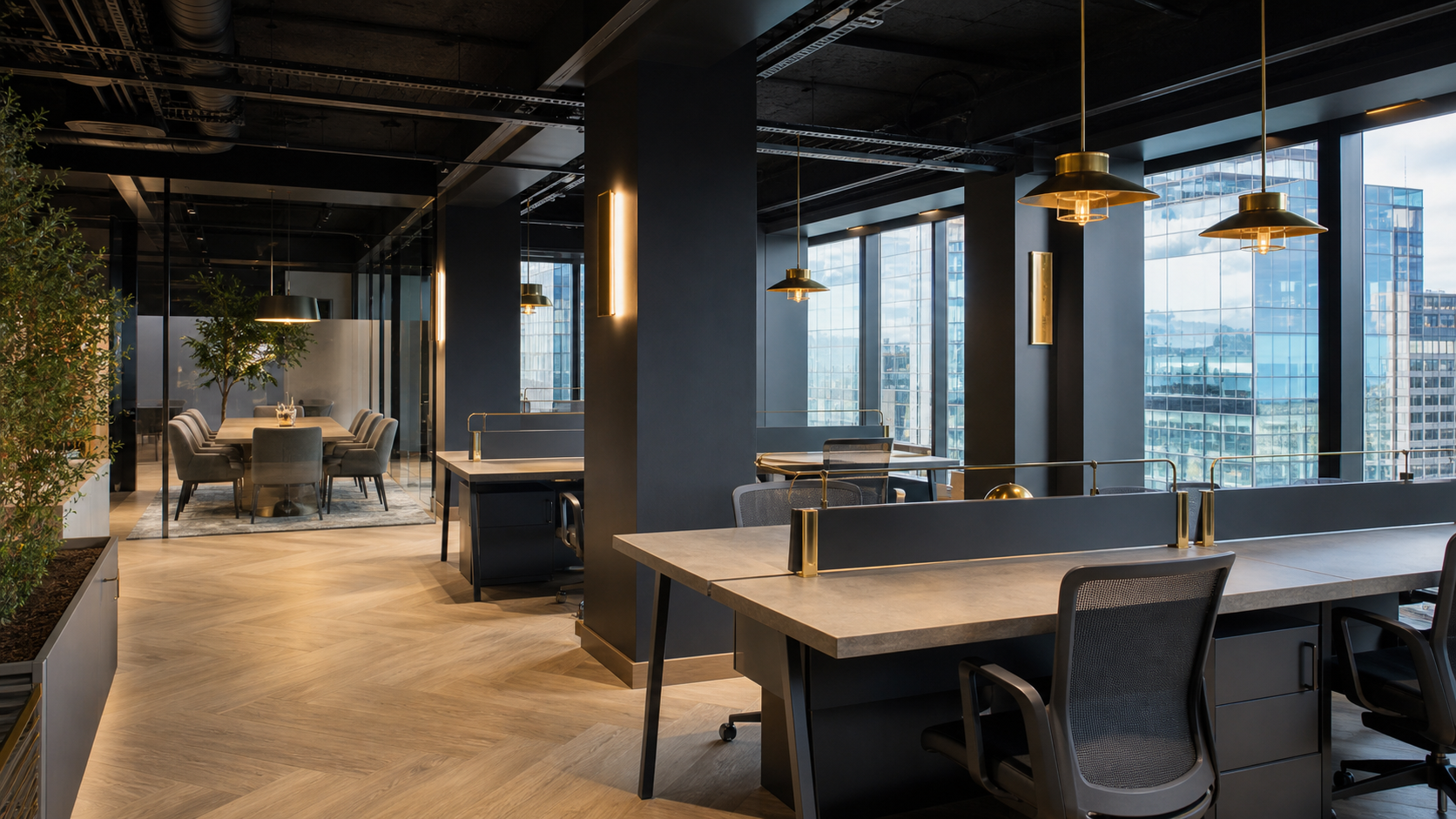
- Task seating and workstations. The largest zone by headcount. Task chairs must meet ANSI/BIFMA X5.1. Work surfaces need cable management, adequate depth for monitors, and a finish that holds up to daily contact. Ergonomic adjustability matters here: seat height, lumbar support, and armrest configuration vary by user. Plan for a range of chair models rather than a single specification when the workforce spans a wide range of body types.
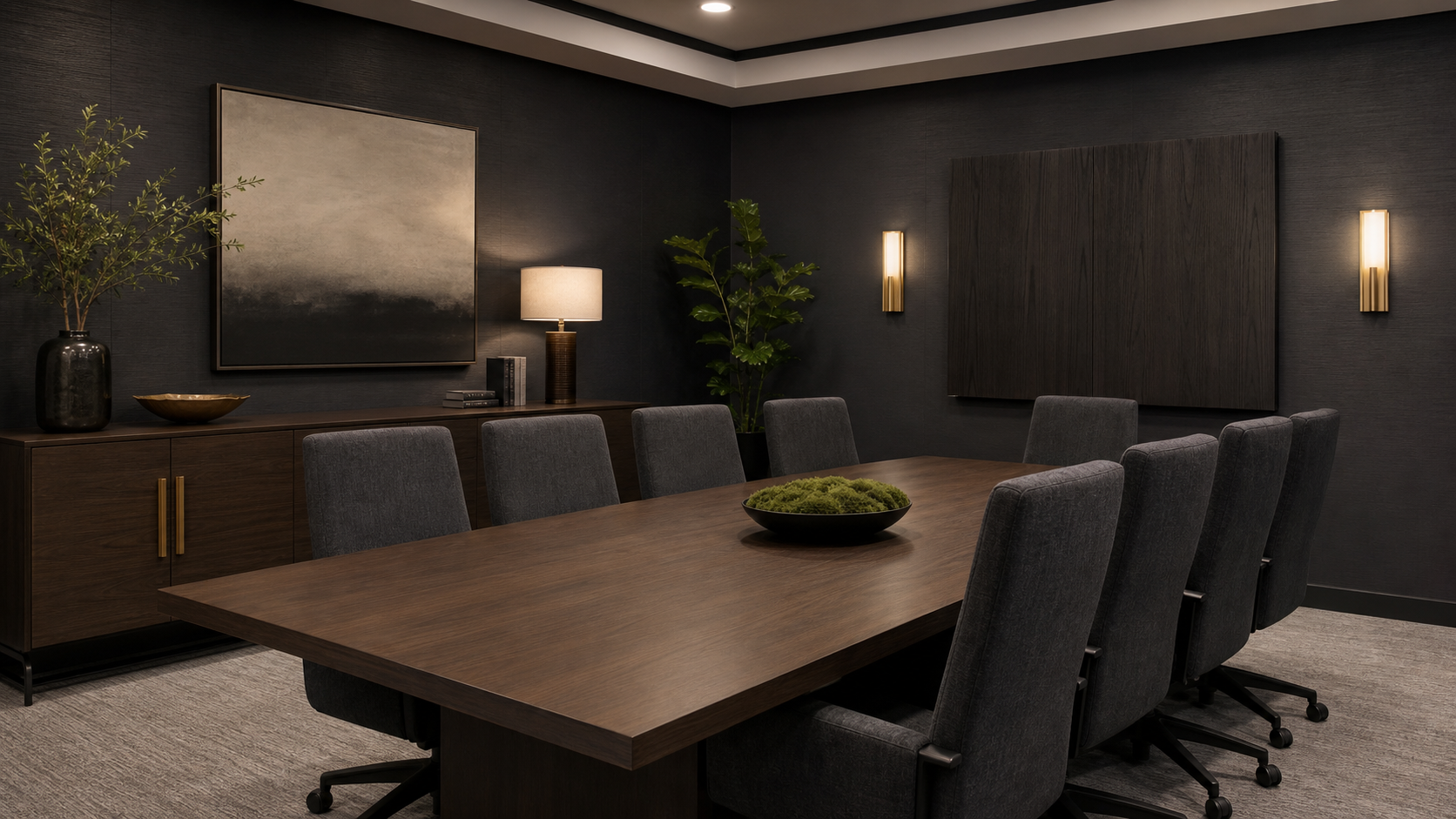
- Conference and meeting rooms. Higher-visibility zone. The conference table is one of the most photographed surfaces in any office. Specify work surfaces in materials that photograph well: real wood veneer, solid HPL in a warm tone, or stone-look porcelain for premium fit-outs. Conference chairs see less daily use than task chairs but need a cleaner, more formal profile. ANSI/BIFMA compliance still applies.
- Collaborative and lounge zones. Soft seating, lounge chairs, and modular soft-seating configurations. These pieces carry an aesthetic weight disproportionate to their footprint. They are photographed for marketing materials, seen by visitors, and used by employees for informal work and breaks. Specify commercial-grade upholstery with a minimum Wyzenbeek abrasion rating of 50,000 double rubs for heavy-use office settings. Foam density of 1.8 lb per cubic foot or higher prevents early sag.
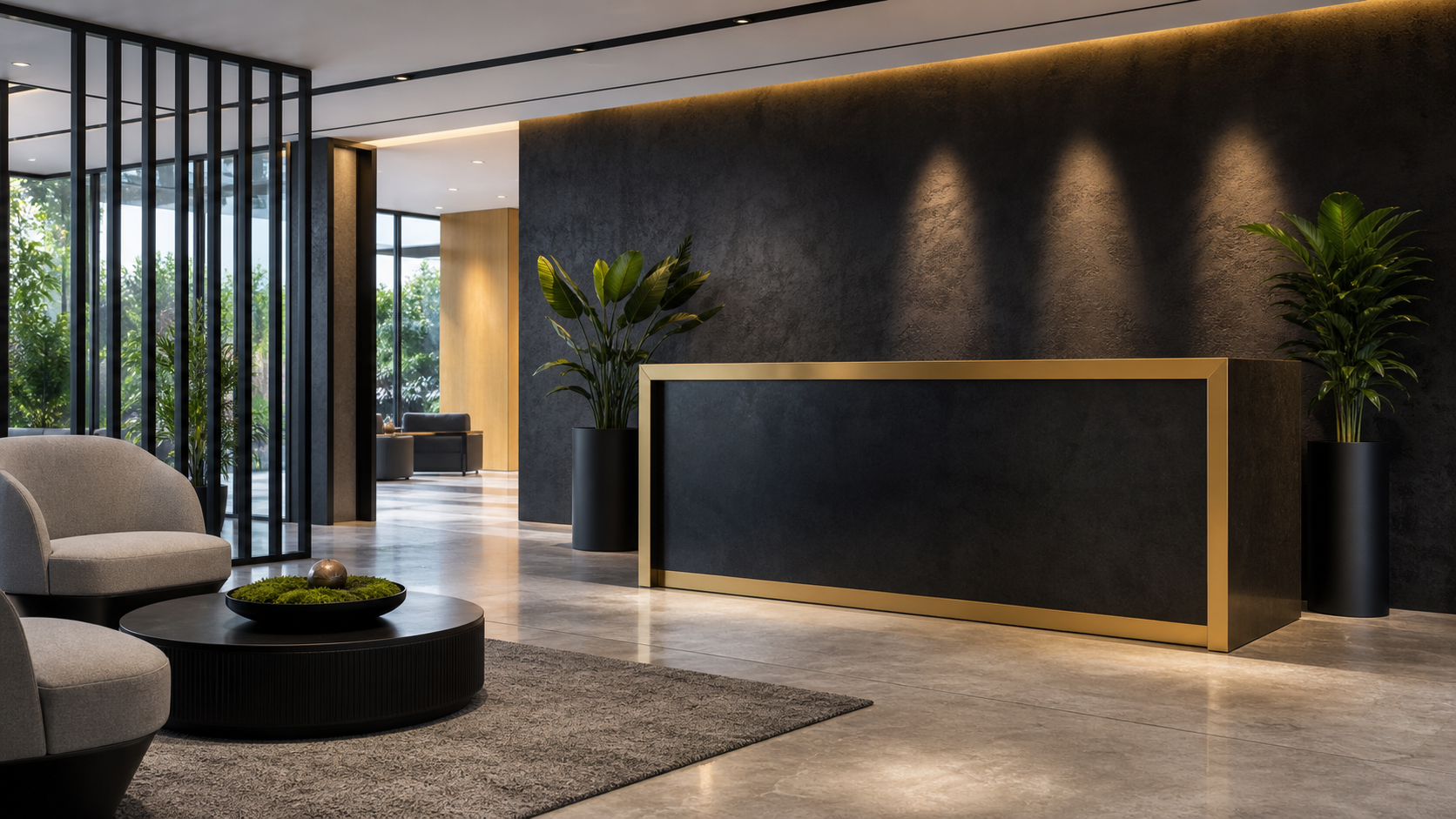
- Reception. The first thing a visitor sees. Reception seating and surfaces set the brand tone before anyone speaks. Match finish selections here to the rest of the specification. Mismatched materials in reception against the interior specification is one of the most common fit-out errors. Confirm the reception desk, seating, and any accent tables are specified from the same or coordinated finish palette before orders go out.
Browse the full range of commercial office furniture across all four zones, including task seating, conference, lounge, and reception.
Choosing Work Surface Materials
Work surface material is one of the highest-impact decisions in a commercial office specification. It affects appearance, durability, maintenance burden, and how the space photographs over time. The right choice depends on the zone, the traffic level, and the project budget tier.
High-pressure laminate (HPL) is the commercial workhorse. It resists scratching, moisture, and cleaning chemicals. It holds its appearance over years of daily use. It is available in hundreds of finishes including wood, stone, and solid colors. For task workstations and conference tables in mid-range commercial fit-outs, HPL is the standard specification for good reason.
Real wood veneer over a stable substrate is the premium step up. It photographs better than laminate, reads warmer in person, and ages with character rather than degrading. The trade-off is maintenance: veneer surfaces need occasional refinishing and are more sensitive to spills than HPL. In our project experience, veneer is the right call for executive offices, boardrooms, and reception desks where the visual impact justifies the care requirements.
Melamine and thermofoil are not suitable specifications for commercial projects. Both chip and peel under the physical contact and cleaning that commercial environments generate. They reduce upfront cost and increase total cost of ownership. If a project is budget-constrained, the right trade is to specify fewer pieces in HPL rather than more pieces in melamine. Our value engineering guide for commercial furniture covers where to trade down without hitting durability.
Lead-Time Sequencing Against the Construction Schedule
Furniture lead time is the variable that most commercial projects underestimate. The industry default for contract furniture runs 12 to 20 weeks from purchase order to delivery. DMD Furnishing commits standard scopes in roughly 9 to 10 weeks because design, manufacturing, and install run under one roof. Waiting until the construction schedule is nearly complete before placing orders almost guarantees that furniture arrives after the intended occupancy date.
The right trigger for furniture purchase orders is the approval of interior partition drawings, typically around the 50 percent construction milestone. At that point, room dimensions are confirmed, outlet locations are locked, and the designer can finalize furniture layouts with confidence. Earlier orders carry the risk of specification changes; later orders carry the risk of missing the opening date.
Delivery and installation sequencing matters as much as lead time. Furniture cannot move through a building until flooring is down and base building is substantially complete. Large items, conference tables, and modular components need elevator access during a specific window. Miss that window and the installation either gets delayed or requires significantly more labor to hand-carry through stairwells. Coordinate the installation date with the general contractor, not just the furniture vendor.
East Coast projects have a logistics advantage when sourcing from a domestic supplier. Shorter transit distance compared to overseas shipments means less exposure to port delays, shipping damage, and the carrying costs of product sitting in a container for eight weeks. It also means faster resolution when something arrives wrong.
Why Single-Vendor Coordination Beats Split POs
Splitting a commercial fit-out across multiple furniture vendors is the most common procurement decision that looks efficient and isn't. Each vendor manages their own lead times, delivery windows, installation crews, and warranty terms. When something goes wrong, which it does on every project of meaningful size, there is no single point of accountability. Each vendor points at the others. The project manager owns the problem.
A single-vendor approach puts one contact in charge of the entire furniture scope. That vendor coordinates delivery sequencing so task chairs don't arrive before workstations, and lounge pieces don't block the installation path for conference tables. They manage the installation crew against the GC schedule. They handle punch-list items without the project manager mediating between suppliers.
Finish consistency is the other argument for single-vendor coordination. When reception seating, conference chairs, and task chairs come from three different suppliers with three different upholstery programs, getting a consistent charcoal or warm-grey specification across the office is genuinely difficult. Color matching between supplier programs is imprecise. In our project experience, finish mismatch is one of the most common issues that emerges when clients split the procurement across vendors.
Working with a supplier who designs, builds, and installs their own product closes that gap. The owner can see the finish samples and the shop floor. The designer can confirm the specification before production begins. The install crew knows the product because they work with it every day. That is what single-vendor coordination actually means in practice: a single team from specification through install day.
Explore the full commercial office furniture range or learn more about how the procurement process works for hospitality and other commercial project types in our hospitality FF&E procurement guide.
Working through the specification for an office fit-out? Talk through your project scope and timeline with our team.
Schedule a ConversationFrequently Asked Questions
How is commercial office furniture procurement different from buying retail?
Commercial procurement involves specifying furniture that meets contract-grade durability standards, coordinating delivery and installation against a construction schedule, and managing documentation for multiple zones across a single project. Retail purchases are transactional. Commercial procurement is a sequenced process with dependencies on construction milestones, elevator access windows, and punch-list sign-off.
What is ANSI/BIFMA X5.1 and why does it matter for office seating?
ANSI/BIFMA X5.1 is the North American durability and safety standard for office seating. It tests cycle count, load capacity, stability, and structural integrity under commercial-use conditions. Specifying chairs that meet this standard is the baseline for any commercial office project. Residential or non-rated chairs will fail early under daily multi-user use and create warranty and liability problems.
When should office furniture be ordered in a commercial construction project?
Submit furniture purchase orders no later than the point when interior partition drawings are approved, which is typically around the 50 percent construction milestone. Industry lead times often run 12 to 20 weeks, while DMD Furnishing commits standard scopes in about 9 to 10 weeks. Waiting until construction is nearly complete typically means the furniture arrives after the intended occupancy date.
What are the advantages of working with a single vendor for an office fit-out?
A single vendor coordinates all product lines, delivery sequencing, and installation in one scope. Split purchase orders across multiple suppliers create scheduling gaps, inconsistent finishes, and no single point of accountability when something arrives wrong or damaged. On a commercial project, resolving a finish mismatch between two separate vendors costs time that a single-vendor relationship avoids.