
Student Housing Furniture: The Specification Guide
Student housing puts more stress on furniture than almost any other commercial setting. Annual 100 percent turnover, move-in and move-out damage, and decade-long replacement horizons mean every specification decision compounds. Get the construction details wrong and you are replacing furniture every three years instead of every ten.
This guide covers the construction details, product categories, and purchasing patterns that matter most when specifying furniture for dormitories, residence halls, and purpose-built student housing. The audience is housing directors, student housing developers, and facilities project managers who need furniture that performs across many academic years, not just the first one.
Quick answer: Student housing is the hardest duty cycle in commercial interiors. Specify for the tenth year, not the first. That means solid joinery with corner blocks, metal fasteners at stress points, thick edge banding, and beds that loft without fighting the frame. Summer-turn logistics are as important as the product spec. Our educational facilities product line is built around exactly this use case.
Why Student Housing Is the Hardest Duty Cycle in Commercial Furniture
Student housing furniture is abused in ways most commercial furniture never sees. Every piece moves at least once per year. Often twice: out in May, back in August or September. Each move involves untrained movers, hallway corners, elevator doors, and students who have never touched a furniture dolly. Damage accumulates fast.
On top of the annual move cycle, students reconfigure their rooms. They drag desks to different walls. They stack casegoods they were not designed to stack. They sit on wardrobe edges and use desk drawers as step stools. In our project experience, the pieces that fail first are almost always the ones whose joinery relied on glue alone, or whose drawer construction depended on stapled corners rather than mechanical fasteners.
The replacement horizon compounds everything. A university housing director does not think about furniture in terms of one building or one year. They think about a portfolio of buildings across a decade. Furniture specified today will be expected to last through at least eight to ten academic years. That is eight to ten move cycles per piece. A product that looks fine after year one but degrades noticeably by year three creates a budget crisis by year five, because now you are replacing furniture that was supposed to last until year ten.
Construction Details That Survive
The difference between furniture that lasts eight years and furniture that needs replacement after three comes down to a small number of construction details. Most of them are invisible once the piece is assembled, which is why they are easy to overlook in a specification review that focuses on appearance and price per unit.
Corner blocks. Every frame joint on a student housing case piece should have a solid wood or heavy-duty polymer corner block glued and screwed into the interior corner. Corner blocks distribute racking forces across a larger glue and fastener surface, which is what prevents the piece from loosening and wobbling after repeated impact. Furniture without corner blocks relies entirely on the panel-to-panel fastener and a thin glue line, neither of which survives years of lateral force from moves and reconfiguration.
Metal-to-metal fasteners at stress points. Cam-lock fasteners and plastic connector fittings are adequate for low-stress interior positions. At high-stress points, which means bed rail connections, wardrobe hinge plates, and drawer slide mounting faces, specify metal-to-metal fasteners. A metal bracket bolted through a panel will hold for a decade. A plastic cam fitting at the same location will strip under repeated disassembly and reassembly.
Thick edge banding. Panel edges are the first place damage shows. Students roll luggage past case pieces, bump drawers closed with their knees, and drag shelves out by their edges rather than their faces. Thin edge banding chips and peels. Specify 2mm or thicker PVC edge banding on all exposed panel edges, applied with hot melt adhesive and properly pressed. Thicker banding takes the hits that thin banding cannot.
Drawer slide grade. Residential drawer slides are not appropriate for student housing. Specify full-extension drawer slides rated for commercial cycle counts. Slides that fail in a dormitory are replaced by students who improvise, which usually means the drawer is removed entirely and the opening is used as open storage, further stressing the case frame. See our commercial furniture manufacturing guide for a detailed breakdown of slide grades and when each applies.
Beds: Loftable, Under-Bed Clearance, and Storage Integration
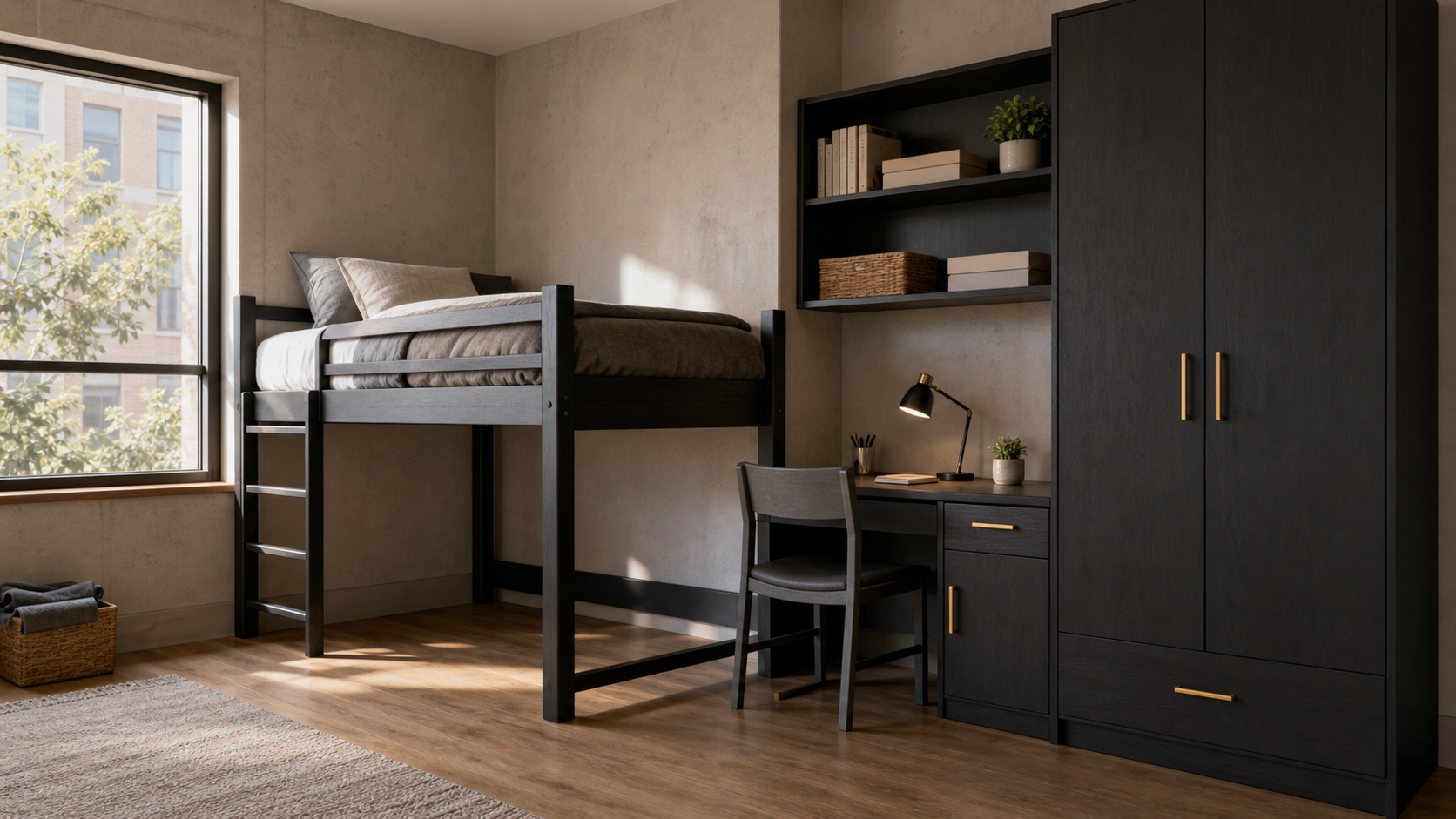
Loftable beds are not a luxury in student housing. They are a functional requirement. Students use the floor space under their beds as primary storage. A bed that cannot be lofted will have its under-bed space claimed informally by whatever the student can fit under the fixed frame height, which is usually very little. Beds that can be lofted to multiple positions give students genuine usable space and reduce the pressure on wardrobes and desks to carry storage they were not designed to hold.
Under-bed clearance matters more than the loft height at the top. At the lowered sleeping position, a minimum of 24 inches of clear height under the frame allows standard storage totes. At 30 inches or more, students can store upright luggage and larger bins without stacking. Beds that loft to full-height but provide only 12 to 14 inches at the lowered position lose the storage benefit entirely for most residents.
Bed frame construction for student housing should use steel or solid-wood side rails, not particle board or MDF. The loft pin mechanism should be metal-on-metal with a positive lock, not a friction fit. Friction-fit loft systems shift under load over time. A student who adjusts loft height once per semester for two years will have loosened a friction system enough to matter by year three.
For residence halls with single-occupancy rooms, integrated storage beds with drawers built into the base frame offer the best space efficiency. For double or triple occupancy rooms, bunking and lofting flexibility is more important than built-in storage, because room configurations change each year.
Desks and Wardrobes
Student housing desks and wardrobes take more reconfiguration pressure than beds. Students move desks to face windows, add monitors, mount shelves, and frequently use the wardrobe top as additional surface storage.
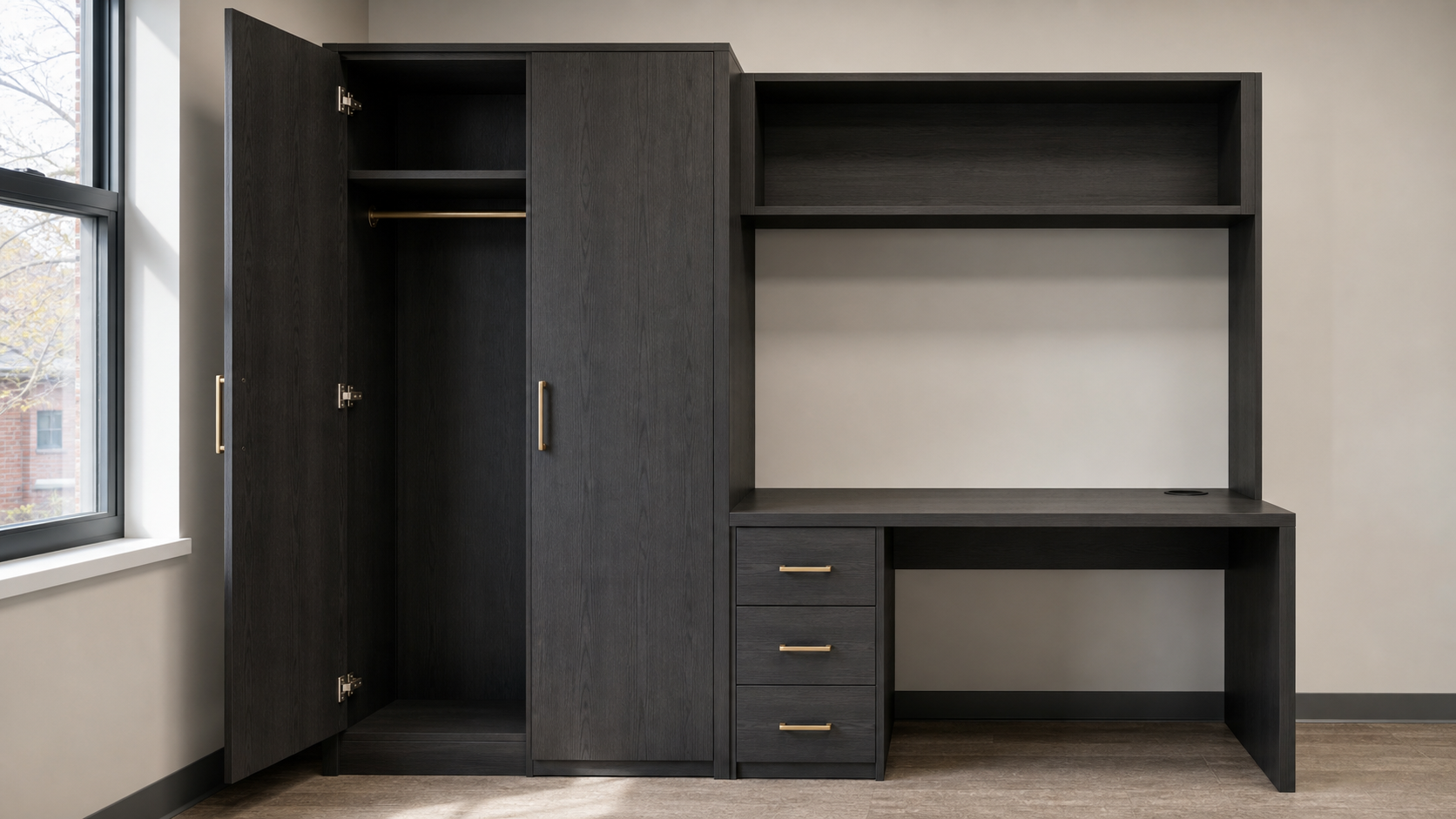
Desks. A student housing desk needs a surface area large enough for a laptop plus notebooks, which means at least 42 inches of width in a single-occupancy room and at least 36 inches in tighter configurations. The desk should include either a fixed overhead shelf or a bookcase return. The overhead component is not decorative. Students will stack items on whatever horizontal surface exists above the desk, and a purpose-built shelf keeps that stacking from creating a safety hazard. Specify grommet holes for power routing rather than assuming students will manage cable placement independently.
Wardrobes. A wardrobe that cannot hold a full academic year of clothing forces students to use desk chairs and floor space as secondary clothing storage. The minimum practical interior hanging height for student housing wardrobes is 48 inches to accommodate coats. Include a top shelf for folded items and at least one drawer or pull-out shelf for smaller items. Wardrobe doors should have full-overlay hinges with soft-close dampers. Soft-close is not a premium feature here; it prevents the door-slam damage that accumulates over years and eventually loosens the hinge plate from the panel.
Both desks and wardrobes in student housing benefit from the same casegoods construction principles that apply to hotel FF&E. If you have worked through hotel guestroom furniture specification, the structural logic carries over directly: panel thickness, corner blocking, and hardware grade all apply in both contexts. The difference in student housing is that the pace of wear is faster.
Common-Room and Lounge Seating
Common rooms and floor lounges in residence halls see high traffic from a rotating population with no ownership stake in the furniture. That combination is worse for durability than the in-room use case, where at least one student is personally responsible for the piece.
Upholstered lounge seating in student common rooms should use commercial-grade fabric rated for high double-rub counts, with a moisture barrier backing. Cushion foam should be high-density, with a minimum of 1.8 lb density, to resist permanent compression. Seat frame construction should be kiln-dried hardwood or steel, not soft wood or particleboard. Soft-wood frames crack under the lateral forces from students who perch on armrests and lean against frame corners.
Seating configurations for common rooms should avoid large, heavy sofas that cannot be repositioned. Students and resident advisors reconfigure lounge layouts frequently, especially at the start of each academic year. Modular seating or lighter individual chairs are more practical than sectional pieces that require two people and furniture sliders to move. Tables in common rooms should have bases and edges that tolerate students sitting on them, because they will. Specify table frames with the same structural intent as a desk that will take standing weight.
For the full range of casegoods and seating options specified for educational settings, the educational facilities product line covers in-room furniture, lounge seating, and study area configurations together.
Summer-Turn Logistics
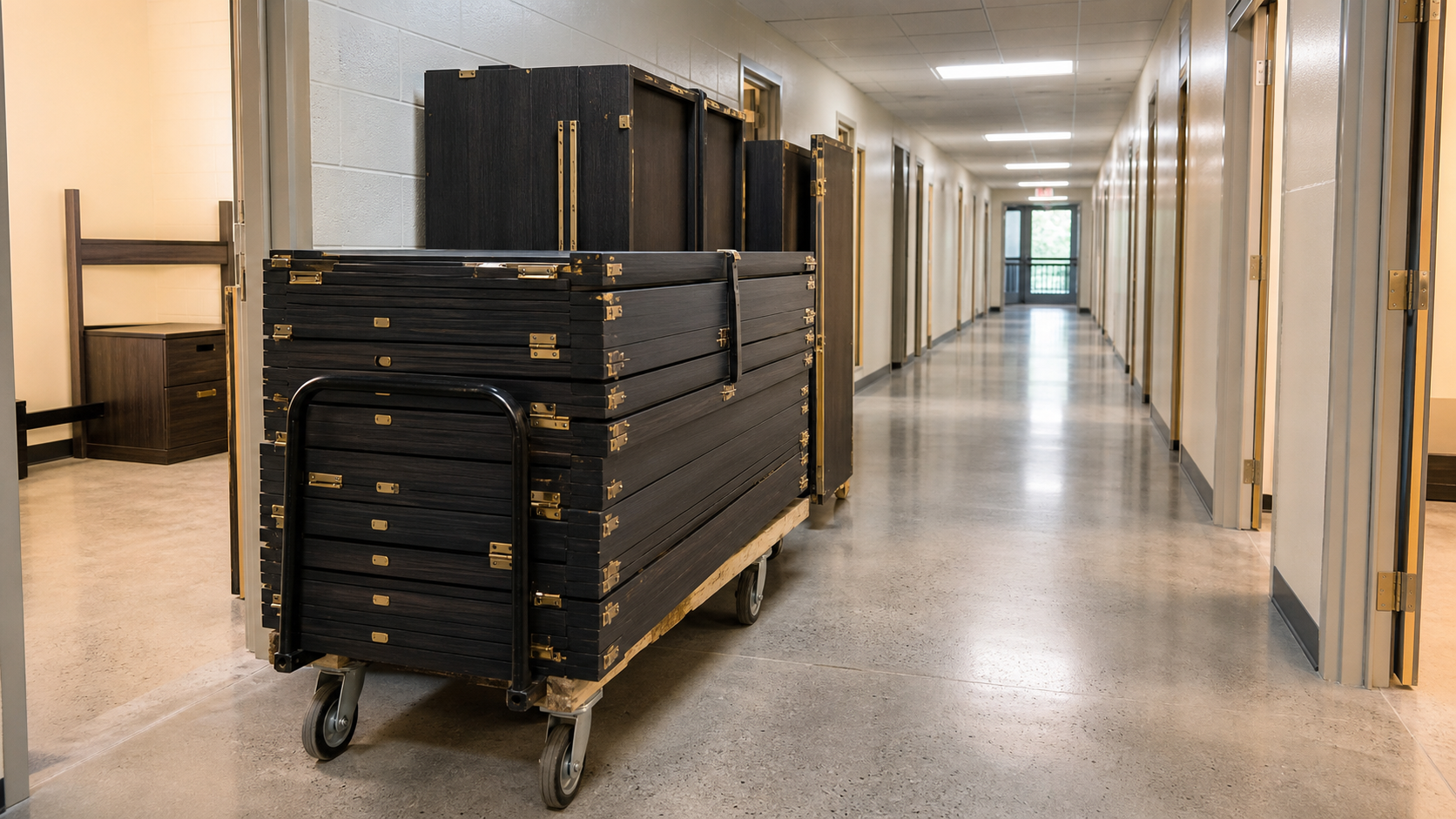
The practical replacement window between spring move-out and fall move-in at most universities is six to ten weeks. That window includes damage assessment, budget approval, purchase orders, production lead time, delivery, and installation. It is a short window to manage a large scope of work, and it compresses further in years when a building is undergoing concurrent maintenance work.
The suppliers who can hit that window reliably are the ones who control their own production and their own install crew. When a supplier brokers production to a third party and coordinates installation through a separate contractor, any delay in either chain pushes the delivery into move-in week. In our project experience, the install-day coordination piece is where most delays actually happen, not the production timeline. A crew that arrives with incomplete hardware, a truck that pulls up in the wrong sequence, or a building access coordination problem on install day costs more time than a one-week production delay.
Standard production scopes for student housing projects typically run nine to ten weeks from order to delivery, compared to an industry default of twelve to twenty weeks for custom commercial casegoods. That shorter timeline is a direct function of owning the shop floor rather than queuing behind other clients at an outside manufacturer. The East Coast location also reduces logistics time for projects in the mid-Atlantic and Northeast, where many large university housing portfolios are concentrated.
Institutional Purchasing Patterns
University housing departments rarely purchase furniture campus-wide in a single order. The standard pattern is phased purchasing by building or wing, aligned to capital budget cycles and the summer turn schedule.
Phased purchasing works well when the supplier can hold consistent specifications across multiple order years. A university that furnishes Building A in year one and Building B in year three needs the same desk, bed, and wardrobe spec available in year three at a predictable price, with matching finishes. Finish consistency across production runs is a real constraint in high-volume manufacturing; it requires the supplier to document the specification in enough detail that the year-three production matches year one without visual drift.
Warranty expectations in institutional purchasing are different from hospitality. Hotel operators accept that soft goods wear out faster than hard goods and plan replacement cycles accordingly. University housing directors tend to expect a single warranty commitment that covers the full piece for a longer horizon. A five-year warranty on frames and a separate upholstery warranty is a reasonable starting point for negotiation. The more important factor is the supplier's track record of honoring warranty claims at scale, which means responding to damage reports and shipping replacement parts within the turn window, not just committing to coverage in writing.
For institutions evaluating a first project before committing to a phased program, a single building or a single floor is a reasonable pilot scope. It produces real performance data on a live population within one academic year and gives the facilities team direct experience with the install coordination process before scaling.
Ready to work through the spec for your next student housing project? We are happy to review your building program and talk through product selection, lead times, and phasing.
Schedule a ConversationFrequently Asked Questions
What construction details make student housing furniture last a decade?
The details that survive long-term student housing use are solid corner blocks at every frame joint, metal-to-metal fasteners at stress points, thick edge banding on case panels, and drawer slides rated for commercial cycle counts. Furniture built to residential cabinet standards will loosen and fail within two or three academic years under annual move cycles.
Should student housing beds be loftable, and what clearance is needed underneath?
Loftable beds are strongly preferred in student housing because students use the under-bed space as their primary storage zone. A minimum of 24 inches of clear height under the lowered sleeping surface is the baseline; 30 inches or more allows most storage totes and small luggage without stacking. Beds that cannot be lofted consistently lose the under-bed space to the first generation of students who force the frame, which damages it.
How should universities plan for the summer-turn furniture replacement window?
The practical replacement window between move-out and move-in at most universities is six to ten weeks. That window includes damage assessment, purchasing decisions, delivery coordination, and installation. Working with a supplier who controls their own shop and install crew, rather than brokering through multiple vendors, is the only reliable way to hit that window without compromising the next academic year.
How do universities typically purchase student housing furniture in phases?
Most university housing departments purchase by building or wing rather than campus-wide in one order. A phased approach allows budgets to be allocated by fiscal year, lets the facilities team verify performance in one building before scaling, and keeps replacement cycles staggered so not every building needs work in the same summer. The key requirement for phased purchasing is that the supplier can hold consistent specifications across multiple order years.