Published · Updated · By DMD Furnishing Editorial Team
HPL vs Veneer vs Solid Wood: Choosing the Right Surface for Hotel Casegoods
HPL (high pressure laminate), hardwood veneer, and solid wood are the three primary surface options for hotel casegoods, each trading cost, durability, authentic grain, and repairability differently.
The short answer: use HPL on high-traffic surfaces in economy and limited-service properties, introduce veneer accents at midscale and upscale tiers, and reserve solid wood for premium detail work in luxury and boutique hotels. The longer answer depends on where each material sits in the room, how housekeeping maintains it, and what the brand standard requires.
Why Surface Selection Matters for Hotel Casegoods
Hotel casegoods (headboards, night stands, bed frames, desks, TV media panels, amenity towers, luggage benches, and vanities) see sustained daily use combined with cleaning chemical exposure that residential furniture never encounters. A surface that reads beautifully in a showroom can fail within two years of housekeeping cycles if it is not specified for the environment. At the same time, the surface material is one of the most visible quality signals a guest perceives when they enter a room.
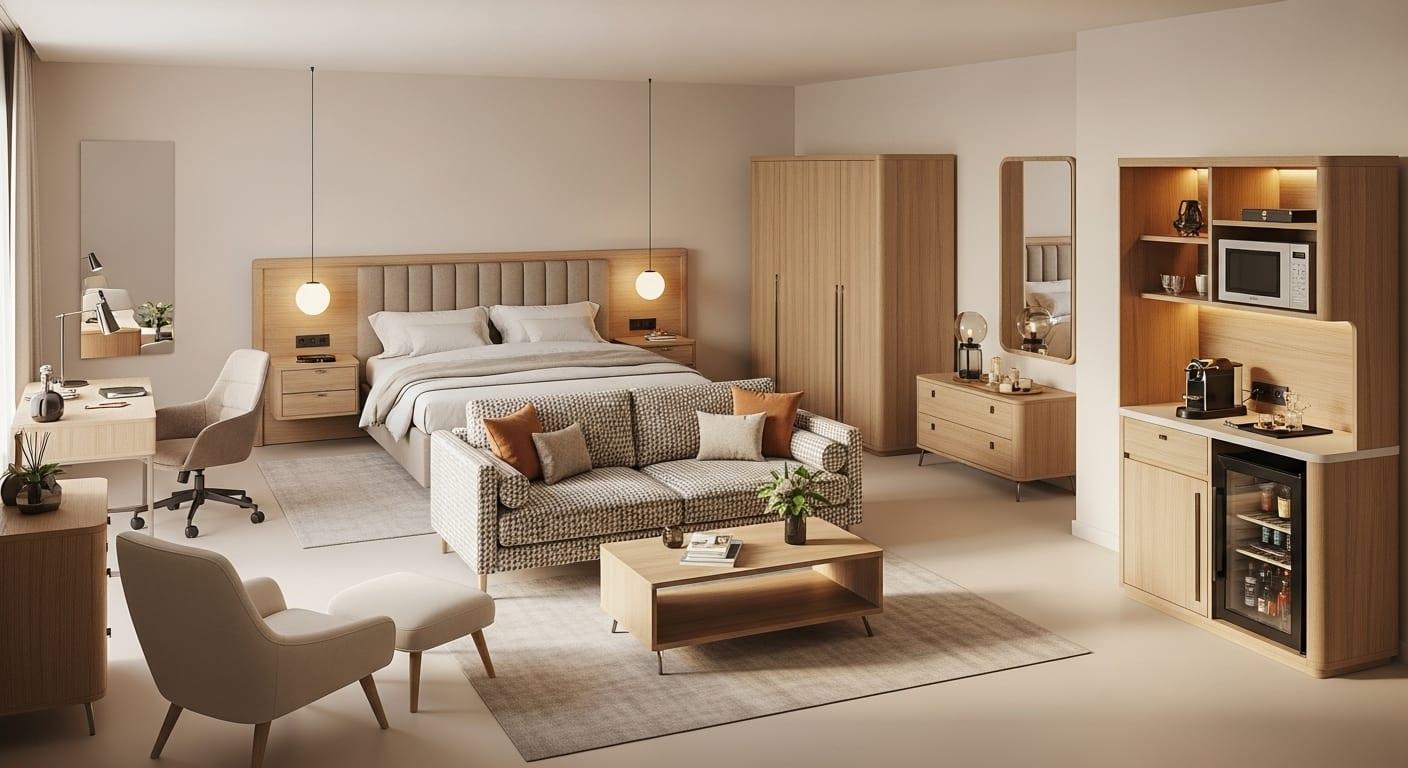
Selecting the right surface is therefore both a durability decision and a brand positioning decision. Understanding how each of the three primary options performs in practice is the starting point for any hotel casegood specification. For how these material choices fit into the wider build process, from construction standards to factory QC, see our commercial furniture manufacturing guide.
HPL (High-Pressure Laminate)
High-Pressure Laminate is manufactured by bonding layers of resin-impregnated paper under high heat and pressure. The result is a dense, hard surface that resists scratches, abrasion, most cleaning chemicals, and moisture (critical for hotel environments). HPL is specified at desk tops, night stand tops, vanity surfaces, and TV media panels across commercial projects from healthcare to hospitality precisely because it performs predictably over time.
Key Characteristics
- Durability: Excellent scratch and abrasion resistance. Withstands repeated cleaning with commercial disinfectants without surface degradation.
- Moisture resistance: High. Edge-banded MDF carcass with HPL surfaces is the standard specification for bathrooms and vanity areas where moisture exposure is routine.
- Consistency: HPL is manufactured to uniform color, texture, and thickness. Large orders produce identical results across every unit, which is critical for multi-room hotel installations.
- Cost: Lower material cost than veneer or solid wood at equivalent thicknesses and finishes. Efficient to fabricate at scale.
- Aesthetic ceiling: Modern HPL prints convincingly replicate wood grain and stone patterns, but the surface lacks the depth and variation of natural materials. Close inspection at key surfaces in luxury properties may not meet brand standards.
Where HPL Appears in Commercial Hotel Casegoods
HPL over an MDF carcass is the standard construction for the majority of commercial hotel casegoods. In product specifications, you will typically see this described as Laminate/MDF carcass, meaning a laminate surface applied to an MDF substrate with edge-banded details. This construction is used across desk surfaces, night stand tops, TV media panel facings, and luggage bench tops where durability requirements are highest. For the full roster of pieces these surfaces appear on, see our hotel guestroom furniture checklist.
Wood Veneer
Wood veneer is a thin slice of real wood, typically 0.5 mm to 3 mm thick, bonded to a substrate, usually MDF. It delivers the natural grain, warmth, and visual depth of wood at a fraction of the material cost of solid wood. Research on wood behavior, moisture response, and material performance is published by the USDA Forest Products Laboratory, a primary reference for understanding how wood and wood-composite materials perform in real-world applications. Veneer allows designers to specify exotic or figured wood species across an entire room without the weight, cost, or dimensional stability issues of solid construction.
Key Characteristics
- Aesthetics: Natural wood grain with genuine depth and variation. Species range from walnut and oak to teak and maple gives designers wide latitude for brand expression. No two panels are identical, which creates a handcrafted quality perception.
- Moisture sensitivity: Veneer is more susceptible to moisture than HPL. Prolonged exposure, particularly at edges and joints, can cause delamination or raised grain. Not the right specification for surfaces directly adjacent to wet areas without sealed edges and a protective finish coat.
- Maintenance: Requires more careful cleaning than HPL. Harsh chemicals and abrasive cleaning pads will damage the finish. Housekeeping protocols need to account for this in upscale properties.
- Cost: Higher than HPL due to wood material cost, matching and selection labor, and finish requirements. Varies significantly by species and figure.
- Repairability: Minor surface scratches in veneered pieces can sometimes be addressed with touch-up kits; deeper damage typically requires panel replacement.
Where Veneer Fits Hotel Casegood Specifications
Veneer is most effective on prominent vertical surfaces where guests interact visually: headboard panels, wardrobe door faces, credenza fronts, and desk fascias. Quality and installation standards for architectural woodwork, including veneer grading and matching, are defined by the Architectural Woodwork Institute, whose standards are commonly referenced in commercial furniture specifications. In product specifications, this is reflected in materials called out as Laminate/Veneer; edge-banded MDF, a mixed construction where veneer is applied to key visual surfaces and laminate handles functional surfaces. This targeted use controls cost while preserving the natural material appearance where it delivers the most brand value.
Solid Wood
Solid wood refers to lumber cut directly from timber with no added lamination layer. It is the most premium specification and carries the most distinctive tactile quality: weight, warmth, and a density that communicates durability. In hotel casegoods, solid wood is rarely used throughout an entire piece; more commonly it appears in structural elements, legs, frames, and decorative details.
Key Characteristics
- Premium perception: Solid wood communicates quality unambiguously. Guests who touch a solid wood bed frame or desk leg register the difference from hollow or composite construction.
- Weight: Significantly heavier than equivalent MDF or plywood constructions. This affects shipping cost, installation labor, and floor loading in high-rise properties.
- Dimensional movement: Solid wood expands and contracts with humidity changes. Hotel rooms with HVAC systems that create wide humidity swings require careful joinery and finish selection to prevent cracking or warping over time.
- Cost: Highest of the three options. Species, grade, and origin all affect pricing. Sustainable sourcing certifications (FSC, PEFC) add a further premium but are increasingly required by brand standards.
- Maintenance: Requires periodic refinishing on surfaces that see direct contact. Scratches and dents are more visible on solid wood than on HPL, though they can often be sanded and refinished rather than replaced.
Side-by-Side Comparison
| Attribute | HPL | Wood Veneer | Solid Wood |
|---|---|---|---|
| Durability | Excellent | Good | Good to Excellent |
| Scratch resistance | Excellent | Moderate | Moderate |
| Moisture resistance | Excellent | Moderate | Low to Moderate |
| Aesthetic quality | Good | Very Good | Excellent |
| Consistency | Excellent | Good | Variable |
| Relative material cost | Low | Medium | High |
| Maintenance requirement | Low | Medium | Medium to High |
| Weight | Light | Light | Heavy |
Practical Recommendation by Hotel Tier
Surface material selection should align with the property's brand tier, average daily rate, and the level of housekeeping intensity the operation can sustain. The following guidance reflects how these materials are practically applied across the hospitality market:
Economy and Limited-Service Hotels
Primary specification: HPL throughout. Economy properties prioritize durability and ease of maintenance above all else. HPL on an MDF carcass delivers both. The cleaning chemical exposure in this segment is high and housekeeping protocols are fast-paced, making HPL the rational choice for every casegood surface. Contemporary HPL prints in wood-tone finishes maintain a clean, modern appearance without the maintenance demands of natural materials.
Midscale and Upper-Midscale Hotels
Mixed specification: HPL base with veneer accents on key surfaces. At this tier, guests begin to evaluate room quality more critically. Introducing veneer on headboard panels, wardrobe door faces, and the front fascia of a desk or credenza signals quality without specifying it throughout. The specification typically reads as Laminate/Veneer on guest-facing surfaces and straight laminate on functional surfaces, an efficient allocation of material budget toward visible impact. That targeted approach is the core move in value engineering commercial furniture without losing design intent.
Upscale and Upper-Upscale Hotels
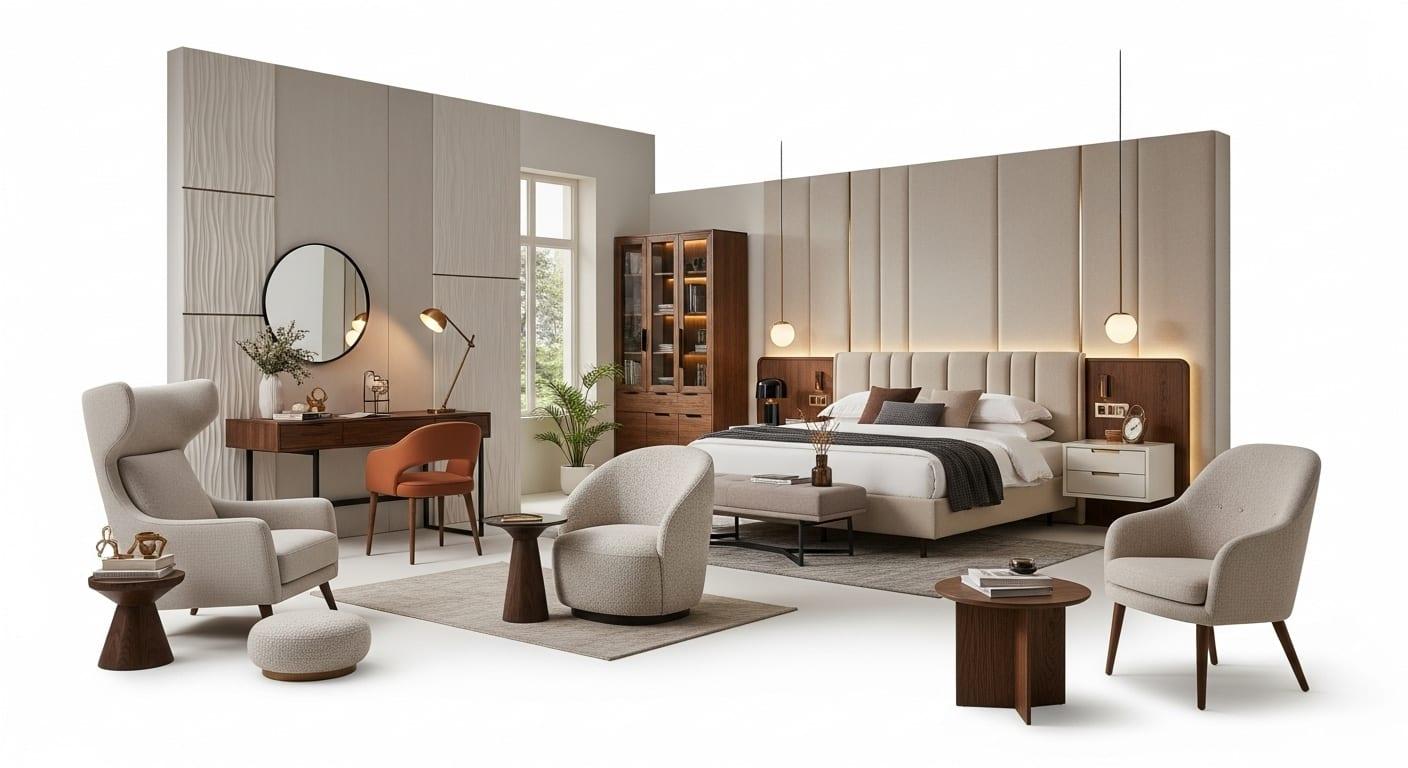
Veneer-dominant with solid wood details. In this tier, veneer surfaces across headboards, wardrobe doors, and major casegood faces are standard. Solid wood appears in structural and decorative elements (legs, frames, hardware surrounds) where guests make direct contact and perceive weight and quality. A full-veneer surface program with solid wood accents is both achievable and appropriate.
Luxury and Boutique Hotels
Solid wood prominently featured; veneer on panel surfaces. Luxury properties have the budget and maintenance programs to support solid wood in quantity. Headboards, bed frames, and feature furniture pieces may be specified in solid wood. Veneer handles large panel areas where solid wood would add cost and weight without additional visual benefit. At this tier, species selection, grain matching, and finish quality are as important as material category.
Specification note: DMD's hotel guest room casegoods (headboards, night stands, bed frames, desks, TV media panels, amenity towers, luggage benches, and vanities) are available in Laminate/MDF carcass and Laminate/Veneer constructions with edge-banded MDF and color-match options. This flexibility allows the same furniture program to be specified at different material levels across a brand's portfolio of properties.
Review DMD Furnishing's hotel guest room casegood collection, including material and finish options available for each product category.
Guest Room ProductsExplore the full hotel furniture range across all spaces: guest rooms, corridors, and public areas.
Hotel CollectionFrequently Asked Questions
Is HPL suitable for luxury hotel casegoods?
HPL is suitable for functional surfaces in luxury hotels (vanity tops, desk writing surfaces, and secondary panel backs) where durability matters more than natural material perception. On guest-facing visual surfaces like headboards and wardrobe fronts, luxury properties typically specify veneer or solid wood to meet brand and guest expectation standards.
Can wood veneer handle hotel bathroom moisture conditions?
Not reliably without additional protection. Standard veneer is susceptible to delamination and raised grain in sustained moisture environments. Bathroom vanity surfaces should be specified in HPL or a sealed stone product. Veneer is appropriate for the vanity carcass exterior in dry areas, provided edges are sealed and housekeeping avoids standing water.
What does "Laminate/Veneer; edge-banded MDF" mean in a furniture specification?
This describes a mixed construction: the carcass is MDF (medium-density fiberboard) for dimensional stability, edges are finished with banded laminate for durability and a clean profile, and primary visual surfaces use either laminate or wood veneer depending on the application. It is a standard commercial hotel casegood construction offering both efficiency and aesthetic flexibility.
How does surface material affect hotel furniture lead times?
HPL is the fastest: it is manufactured to consistent specifications and stocked in standard finishes. Veneer adds lead time for species selection, face matching, and panel sequencing. Solid wood has the longest lead time due to material sourcing, drying, and machining requirements. Projects requiring veneer or solid wood should build additional lead time into the procurement schedule.